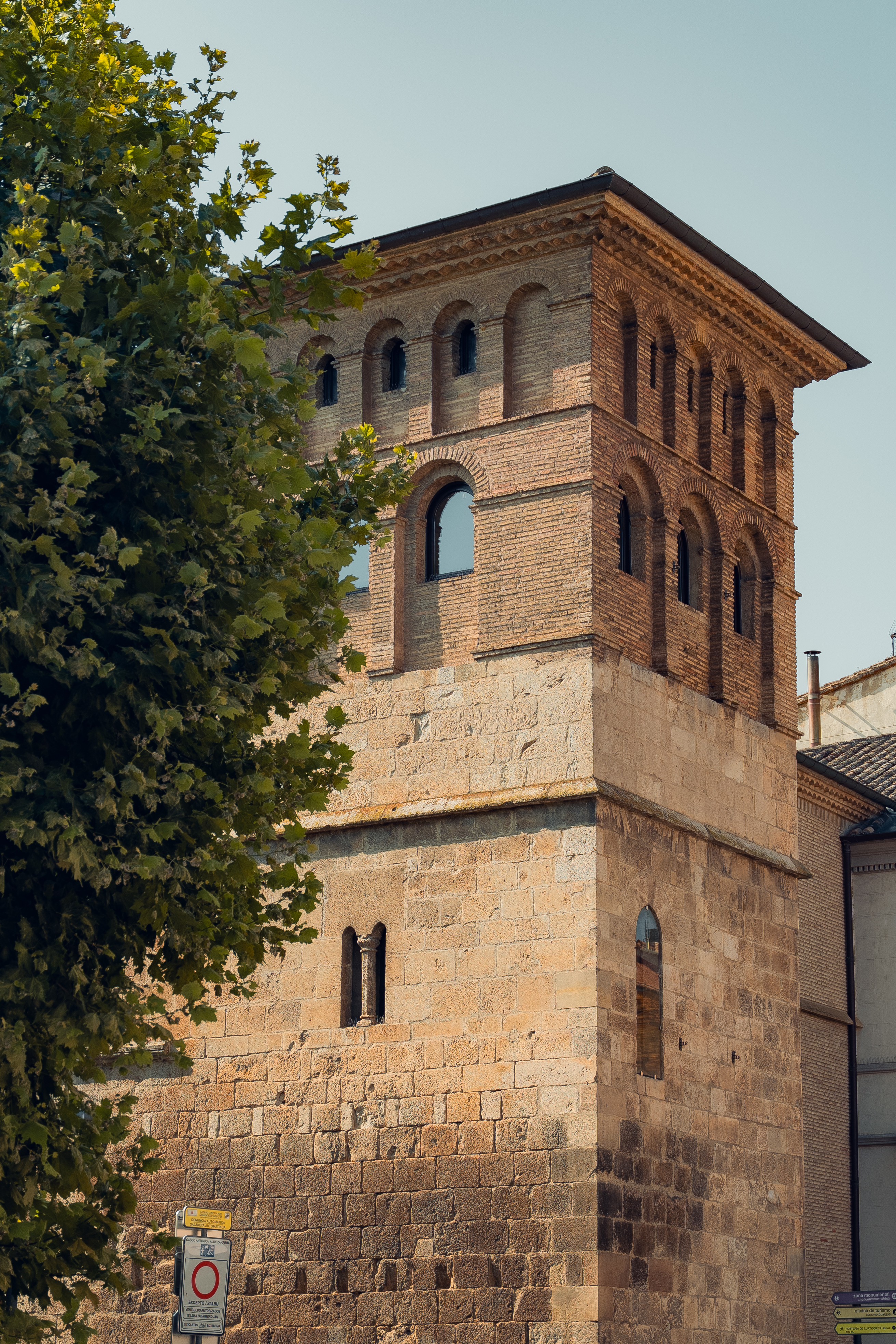
Cirauqui is a historic town where paths, eras, and cultures intersect in a truly unique way. Nestled on a hillside and visible from the Autovía del Camino, it retains the character of a place that has been linked for centuries to the flow of people, goods, and stories. Here, the Roman legacy, the Middle Ages, and the tradition of the Way of St. James continue to form part of the landscape and daily life.
Located at an altitude of approximately 495 meters, the town of Cirauqui is remarkably well-preserved. The town center retains the layout of the old walled medieval town, adapted to the topography with narrow, winding streets that ascend through twists and turns, slopes, and shifting vistas. Medieval gates, remains of the city wall, and stone houses form a compact and well-preserved ensemble, dominated by buildings of rough-hewn stone reinforced with dressed stone, facades bearing coats of arms, doorways with large voussoirs, and architectural details that reflect the economic growth experienced between the 16th and 17th centuries.
The Church of San Román dominates the town’s skyline from above. Its monumental poly-lobed portal, one of the most unique on the Camino de Santiago in Navarre, makes this Romanesque church one of Cirauqui’s greatest heritage landmarks. Alongside it, the Church of Santa Catalina, the Baroque Town Hall, and one of the ancient gateways in the town wall complete a heritage that helps visitors understand the town’s historical significance.
The surrounding area further reinforces this identity as a stopover town. The Roman road of Iguste, the Roman bridge over the Salado River, and the medieval route of the Camino de Santiago transform the landscape into a true journey through centuries of history. Added to this is a winemaking tradition that remains very much alive today, where vineyards, a cooperative winery, and celebrations such as Wine Day keep the connection between the region, its products, and the community alive.
What will you find in the town of Cirauqui?
Town Hall (Ayuntamiento): Built in the Baroque style. It is a building constructed of dressed and rough-hewn stone with a portico featuring lowered arches resting on pillars. Its façade displays a large stone coat of arms of the town. The Camino de Santiago passes through its arcades. It houses an immersion baptismal font from the Aniz Chapel.
Calle Mayor: Medieval in style. It forms one of the rings encircling the town along the hillside, with continuous twists and turns and shifts in perspective. Sixteenth-century buildings abound.
Portal: This is a gate in the old 13th-century city wall through which the Camino de Santiago enters the town. It is built of thick ashlars and features a funerary stele with inscriptions on its right side.
House with a Coat of Arms (17th century): Built in 1693 (according to the inscription “María de Oteyza me fezit”). It preserves an 18th-century stone coat of arms. Several houses of this type can be found throughout the town.
Notable House (17th century): A corner building with an inscription on the lintel reading “Pascoal de URBE. Year 1673.” It has been recently restored.
Mansion (16th century): A building constructed of ashlar stone that retains a semicircular entrance arch with sturdy voussoirs and a small mullioned window with ogee arches.